

From August 13 to September 13, the city of Karlsruhe transforms into an open-air exhibition space.
From the Marktplatz, through the Alte Flugplatz, to the Alb, visitors can experience contemporary media artworks free of charge and gain new perspectives on public space and our role within it. The presentation runs alongside the SCHLOSSLICHTSPIELE Light Festival and, for four weeks, invites visitors to rediscover Karlsruhe through media and light art.
The artistic works occupy central locations – from the Marktplatz to the Alter Flugplatz [old airfield] and along the river Alb. The media artworks create new connections between urban space, nature, and society. They make the invisible visible: microplastics in river water, deforestation as rhythm, climate data as sound. The exhibition runs parallel to the SCHLOSSLICHTSPIELE Light Festival and invites visitors, over the course of four weeks, to rediscover Karlsruhe through media and light art.
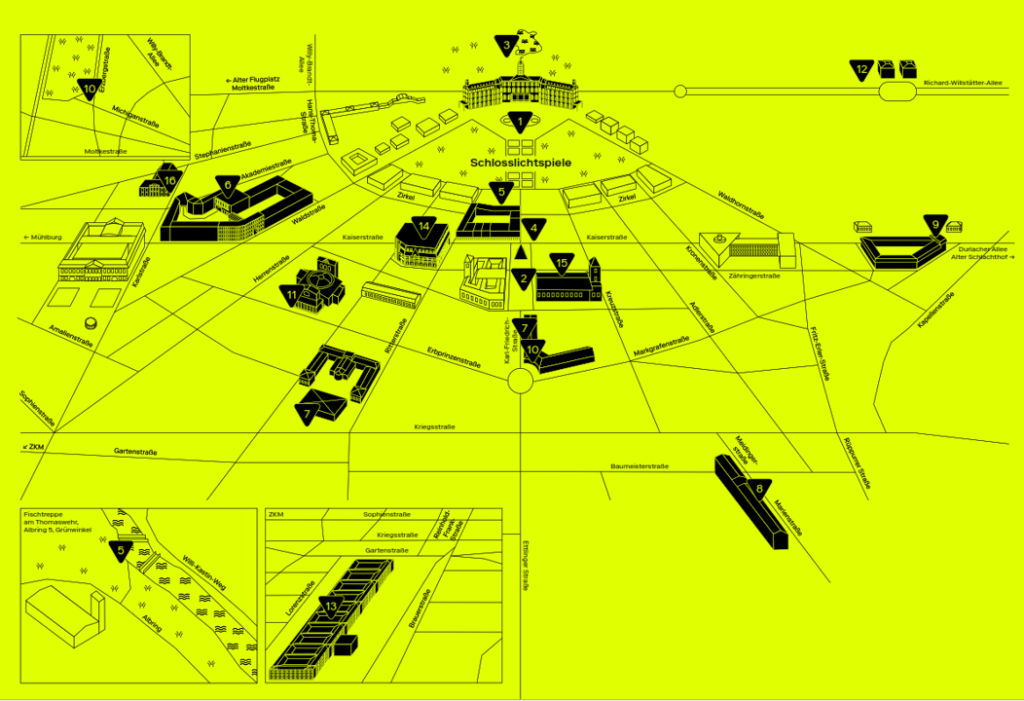
For anyone interested in exploring the exhibited works together, guided tours—on foot or by bike—in German take place every Thursday. More information on dates and registration here.
The artists draw on scientific methods, historical references, and participatory formats to find orientation in a rapidly changing world that challenges liberal-democratic order. They ask: How can we grasp the ecological challenges of our time? What stories do military traces in urban space tell? And how do new forms of community emerge?
Visitors are invited to a shift in perspective – on moss, on bureaucracy, on queer visibility. Media art becomes an instrument of social reflection here: precise, poetic, political.
Several works make environmental changes tangible that would otherwise remain invisible. The artists use scientific methods such as scanning electron microscopy or geodata analysis. These artistic translations create new access to abstract figures, linking local places with global processes – and remind us that seemingly distant ecological crises affect us directly.
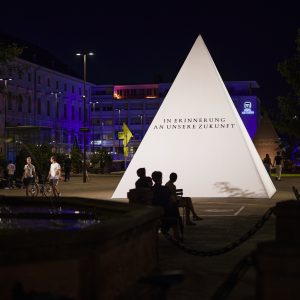
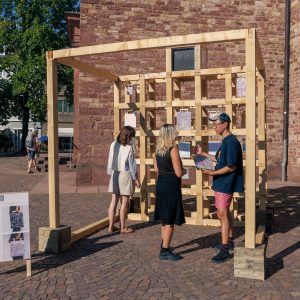
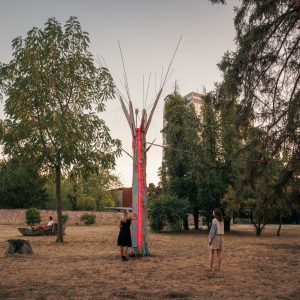
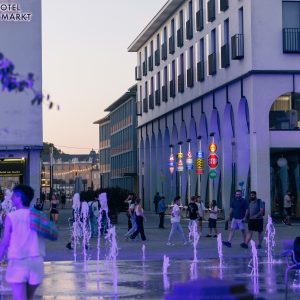
Norina Quinte, Andreas Hölldorfer (ato), and VOLNA make a visual statement on climate change with their Pyramide von morgen [Pyramid of Tomorrow] on the Marktplatz, bridging the city’s history with its ecological future. The media art installation is a temporary, walkable pyramid structure matching the size and shape of the historical pyramid on the square.
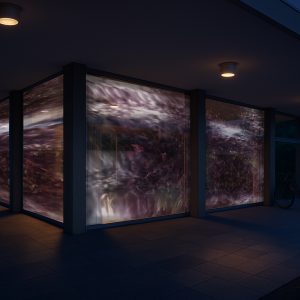
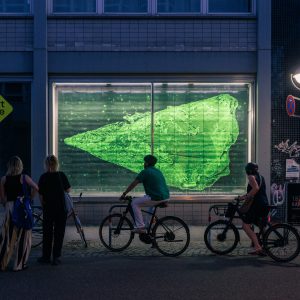
Vera Gärtner, with Live from Plastisphere, makes microplastic pollution in the Alb river visible through very large-format images taken with a scanning electron microscope. Her poetic-scientific approach to local environmental problems is on view at the shop window of the Museum beim Markt and at the fish ladder by the Thomaswehr.
Antoine Bertin, in 555 Hz, translates deforestation statistics into beats per minute. In the resulting rhythm, several metronomes strike and send out a light signal, creating a physically and temporally experienceable monument to this abstract loss in the Schlossgarten.
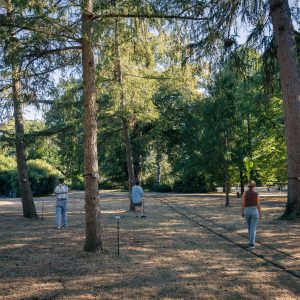
Artist Lucile Schwörer-Merz also works with geodata for her interactive sound installation meteo flux – eine Symphonie der Atmosphäre [a symphony of atmosphere], exhibited in the Fasanengarten. Real-time meteorological data is compared with the 40-year average; deviations are made audible and visible. Depending on the weather and the movement of visitors, her work changes.
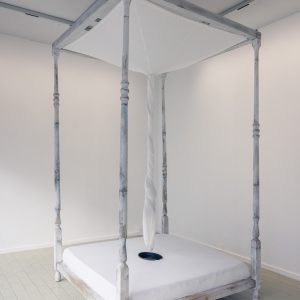
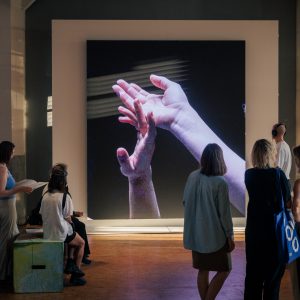
Desiree Kabis and Eveline Vervliet invite a shift in perspective with their installation Through Moss-Colored Glasses. The “moss-colored glasses” announced in the title translate human movements into the language of this often-overlooked lifeform, opening up a queer, non-human view of coexistence and community. The installation can be experienced at the Naturkundemuseum pavilion and at the Regierungspräsidium.
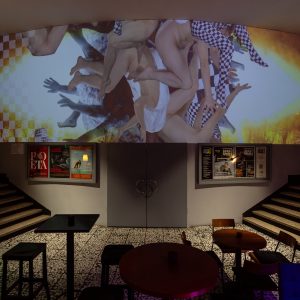
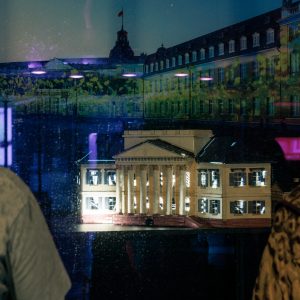
The duo IRIS-A-MAZ transforms Peter Paul Rubens’ The Fall of the Damned into an endless state of suspension in the Kinemathek. Their video work Himmelssturz, developed specifically for the Phonolux machine, turns the cinema foyer into a threshold between reality and film world, between control and liberation.
Other works trace military and socio-political imprints in urban space. They connect historical sites with current questions: about visibility, about safe spaces, about possible futures. These artistic interventions make clear that history is not over – it continues to act through infrastructure.
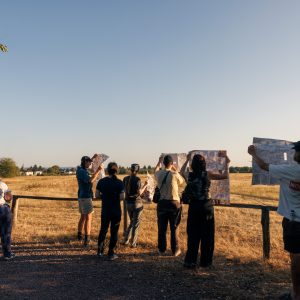
Isabel Motz, Nis Petersen, and Josefine Pilar Scheu pursue the question of what past shapes our present in 2 Flächen bewegen, 50 km/h, Schritttempo. With their performances and an audio walk, they connect two contrasting Karlsruhe locations: the quiet Alter Flugplatz and the busy Kriegsstraße. Through performative walks and car rides, the military imprints of both places are made visible, and questions about the city’s possible futures are raised.
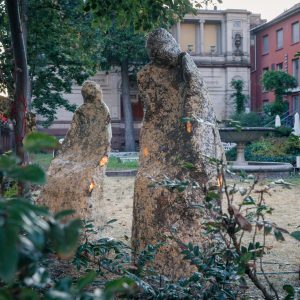
Yulia Mashkova and Grisha Mumrikov raise awareness, in Fragile Homes, of our interpersonal coexistence and the instruments of power that organize it. Their projection for the Schlosslichtspiele, along with the sculptures in public space, remind us that real people are involved, and that the paper on which our bureaucracy is built is a natural and finite resource.
Karolina Sobel addresses queer and feminist visibility as well as the fragility of safe spaces in her video work Soft Signals in the ZKM foyer. The collaborative project was created together with Natia Chikvaidze and Davit Khorbaladze from Tbilisi and takes the Georgian painter Elene Akhvlediani (1898–1975) as its starting point.
Continuing the exchange between the media art cities of Cali and Karlsruhe that began in 2024, Lehel Lajos and Daniela Vargas further develop their work No Longer Not Yet (2025). At Yvonne Hohner Contemporary, Memoraque shows an installation that seems to stem from a dream, bringing it into a tense interplay of river and echo.
SangDoo Nam goes a step further, using public space as a stage for new forms of exchange. His installation turns the Kirchplatz St. Stephan into a special pop-up store where people can trade their stories for images. Here, art becomes a social practice beyond museum preservation.
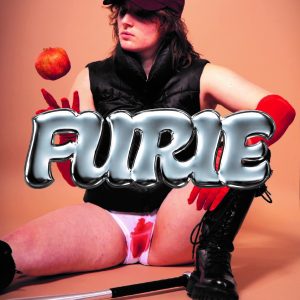
At studio hö, scholarship holder Isabelle Konrad develops a new visual language for female rage in her transmedia project FURIE. It’s no coincidence that the word “hysteria” comes from the Greek hysterá – womb – and that the Furies of mythology were feared as goddesses of vengeance, not as bringers of justice. FURIE asks what happens to this pent-up energy, and what emerges once it finally claims space. The overall project is conceived as a long-term image and sound atlas that grows beyond the scholarship itself.
All exhibited works, except Echo einer Ordnung, FURIE, Fragile Homes, Light up Weinbrenner, Memoraque und One way or another, were funded in 2024 and 2025 by the Medienkunst project funding program of UNESCO Creative City of Media Arts Karlsruhe.