


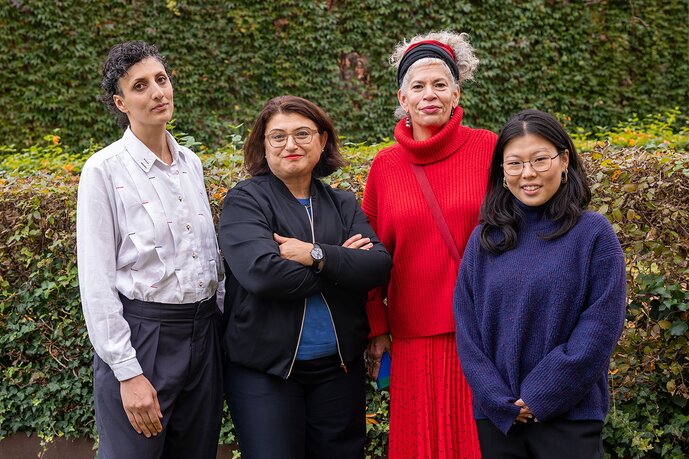
In June 2025, a unique research project on the artistic and scientific promotion of BiPoC+ FLINTA* was launched at the Karlsruhe University of Arts and Design. Led by visual artist Ülkü Süngün, the project is dedicated to analyzing structural barriers to BiPoC+ FLINTA* at art academies. The aim is to develop practical recommendations for action for more visibility, representation and institutional change.
The joint project Critical Faculties. BiPoC+ FLINTA* at art academies is simultaneously investigating structural obstacles to BiPoC+ FLINTA* at art academies and mechanisms that impede the visibility of BiPoC+ FLINTA* and its achievements in the fields of fine arts, art sciences and science at the HfG Karlsruhe and UdK Berlin. BiPoC+ FLINTA* refers to all people who see themselves as women, lesbians, trans*, inter, non-binary or genderqueer and who experience racist and/or anti-Semitic discrimination in Germany due to their (ascribed) origin, religion, language or appearance.
The project combines artistic and academic research. The scientific survey with a focus on racism, inequality and higher education research is supervised by Prof. Ulaş Aktaş and staff at the UdK Berlin. The aim is to use the research findings to develop practical recommendations for reducing and overcoming these obstacles. The effectiveness of these recommendations for action will be tested through scientifically supported participatory practical research.
The artistic research is based at the HfG Karlsruhe in the Department of Media Art and is being carried out as a model project in cooperation with the ABK Stuttgart, the AdBK Nuremberg and the HBK Braunschweig. The interdisciplinary core concept group – the LAB – brings together well-known experts from art and science, including Prof. Diana McCarty, Ülkü Süngün and Anna Feldbein (HfG Karlsruhe), Prof. Heba Amin, Prof. Lucienne Roberts, Prof. Katrin Ströbel and Carmen Westermeier (ABK Stuttgart), Prof. Anike Joyce Sadiq (AdBK Nuremberg) and Prof. Havîn Al-Sîndy (HBK Braunschweig). The starting point of the artistic research are questions on knowledge production and archives, decolonization of algorithms, the art canon in teaching, visual codes and visibility politics in art, drawing as a political gesture, as well as self-institutionalization as an artistic-political strategy.
The results of the interdisciplinary research process will be presented at an international symposium and an exhibition in Karlsruhe in 2027. The documentation will take the form of a bilingual open access publication and project website.
Further information:
https://hfg-karlsruhe.de/en/aktuelles/critical-faculties-bipoc-flinta-an-kunstakademien/
www.innovative-frauen-im-fokus.de
www.kompetenzz.de