


In a digital context, which seduces us into believing in seamless and undistorted communication, corporeal friction in language becomes a form of interference that must be smoothed over. Systems such as automatic speech recognition (ASR) are characterized by hegemonial notions about which voices count, which accents are legible and which linguistic forms are worthy of recognition.
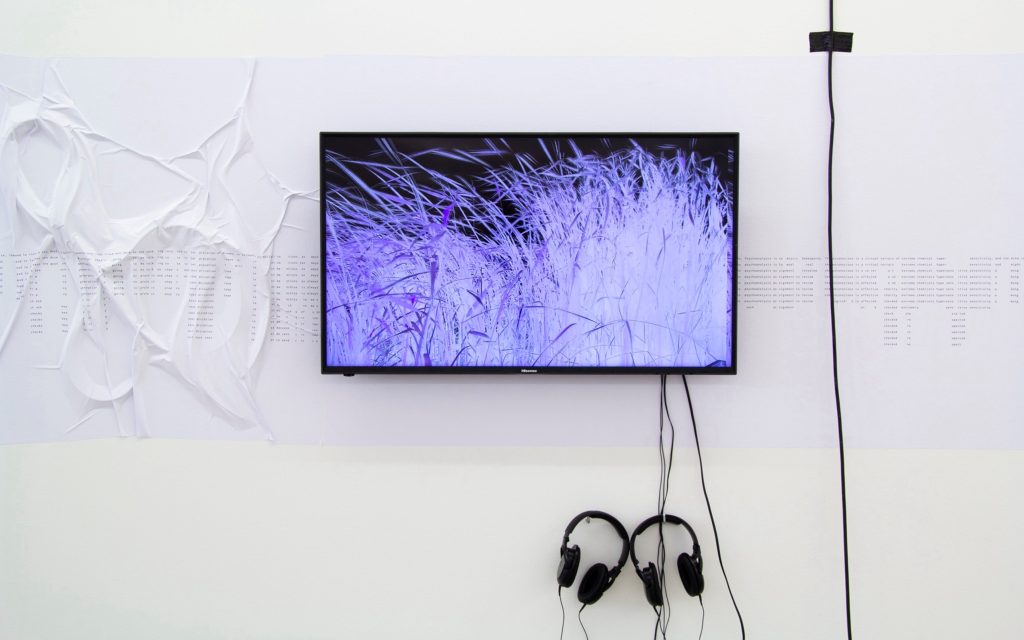
In her practice, the artist Anna Barham (1974, Sutton Coldfield)—whose first major solo exhibition in Germany is being held at the Badischer Kunstverein—searches for ways to resist this smoothing out of language, devoting herself instead of to the untranslatable. In her installations, videos and sound works, Barham brings the linguistic found objects that are deemed incomprehensible by ASR to a “hallucinatory” state.
Her artistic research projects confront urgent questions related to the ethics of linguistic technology, auto-correction, and text recognition, proposing visionary possibilities for deciphering the potential of language that is excluded by normative standards and for opposing ubiquitous forms of authority.
The exhibition receives support from the Innovationsfonds Kunst (Innovation Fund for the Arts) of the Ministry of Science, Research and Arts of the Federal State of Baden-Württemberg.
